Showing posts with label boilerplate. Show all posts

Monday, October 19, 2009

Spacecraft of the Week #8

Tomorrow morning, Tuesday, October 20, shortly after midnight, an event will occur that has not happened in almost 30 years. A new launch vehicle will leave the Vehicle Assembly Building at Kennedy Space Center and make its way to Launch Complex 39B. Atop the Ares I-X booster is our Spacecraft of the Week. The 'Crew Module Simulator' is a boilerplate of an Orion Spacecraft. Mounted on a simulated service module and topped with a Launch Abort System Simulator, the CMS is heavily instrumented to provide feedback of the forces experienced in the launch.

The Ares I-X has been the center of some controversy. Built as a test for the more powerful Ares I, this uprated Space Shuttle Solid Rocket Booster (SRB) was never intended to launch alone. Paired up along side an external fuel tank , SRBs have helped launch Space Shuttles since 1981. With modifications and an extra segment of rocket fuel, the Ares I was intended to launch astronauts to orbit and the International Space Station. Critics fear that undampened vibrations of the burning solid fuel would prove fatal for astronauts aboard. The same fears arose after the Saturn V's first flight. Engineering provided an answer and the Saturn V became one of the most successful boosters in history. The Ares I-X will provide similar data and provide engineers with a benchmark for final development of the Ares I.

But first, the CMS and the Ares I-X need to get to the pad. Tomorrow will be an exciting day for space hardware enthusiasts, and sitting atop the object of their attention will be our Spacecraft of the Week, the Crew Module Simulator.

Friday, September 11, 2009

"Look at the sky"

It was a beautiful morning in Houston, with a few days remaining of our Professional Development Conference at NASA's Johnson Space Center. We aerospace educators met annually at a NASA center to get up to date on the latest NASA education and science programs. The night before, we watched the movie Apollo 13 from the original mission control room, the film being projected on the same screen that displayed the televised images from the moon. When it was my turn to watch from the Flight Director's chair, I stood behind and paced - we never saw Gene Krantz sitting down. Earlier that day, I crossed the street to the municipal complex where a refreshed Apollo boilerplate BP-K had been placed on display. But now, a new day to hear from NASA on how to inspire today's youth.

We were meeting at the Gilruth Center, a multi-purpose facility for JSC employees. Noshing on pastries and morning caffeine, we were slowly making our way to our meeting room. Suddenly, someone came in saying, "Return to your duty stations. Return to your duty stations, now!" Someone said we were from across the country and had no duty at JSC, so we were sent to the meeting room where we were going anyway. Wondering why, we were told that something had happened in New York City, so we turned on the TV projector and saw smoke billowing from the World Trade Center. We watched a little, then tried to start our session while we monitored the video.

When the second plane hit we knew that there was something very serious in the works. The JSC guy who told us to get to our duty stations returned to say that JSC was closing down - planes were being grounded and fear that some were heading toward Washington. Or boss took the podium and offered a choice; remain in Houston until flights resumed or take our rentals and drive home. A call to the rental agency confirmed we could do this (with the appropriate rate increases), so we decided to drive home. Within an hour we were checked out of the hotel, with four of us heading east on I-10. Listening to the radio, we pieced together what had happened and discussed how the world was changed. One colleague remarked, "Look at the sky. Not a contrail in sight. We've never seen a sky without airplanes."

Stay tuned for the rest of this story.

Tuesday, September 8, 2009

Spacecraft of the Week #4

Sometimes you find spacecraft in the oddest of locations. Last weeks SOTW, an Apollo boilerplate used as a time capsule, was originally located on a boulevard median in a small city. This weeks' spacecraft is also found on a a city street, but what it's history is remains unclear.

On the corner of Red Bluff Road and San Augustine Avenue in Pasedena, Texas, across from J.D. Parks Elementary School, a Mercury capsule complete with escape tower is mounted on a low pedestal. I don't know whether to list it as a boilerplate or a model. This has an air of authenticity that a fabricated model lacks, unfortunately due to the amount of deterioration that has taken place - a model would have been created to handle the weather. But several other questions arise besides its heritage. Why here? Nearby Johnson Space Center did not begin operations until Gemini IV, well after the completion of the Mercury project. Why is a lamp mounted on top of the escape tower aerospike? Normally, this would be for aircraft and indicate it may have once been mounted on a tall booster.

I last visited this capsule in February of 2005. Even though it was winter, the grounds were maintained and the shrubbery surrounding it was trimmed. Google Maps show it as still in this location, and Street View gives some good views of it. But the mystery remains behind the unique placement in this Houston suburb, and that is why I chose it for the Spacecraft of the Week.

Monday, August 31, 2009

Spacecraft of the Week #3


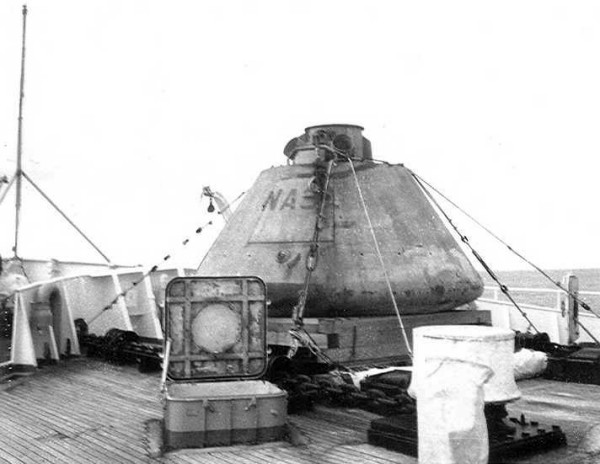
Apollo Boilerplate #1227 was one of many built by NASA to give to Navy and allied ships to train crews in the recovery of a wayward capsule. In an emergency, the Apollo spacecraft could be brought home earlier, even on land (though very hard on the astronauts!) and NASA wanted friendly help available, wherever it may be. Crews needed to be adept at stabilizing the capsule with a floatation collar, extracting the astronauts, and hauling the capsule on board. In 1970, BP-1127 was being used for training by a UK naval vessel when it became lost at sea. The circumstances surrounding this loss are unclear: bad weather and choppy seas, or perhaps a Soviet spy ship disguised as a fishing trawler grabbed it. Whatever the case, BP-1227 wound up in Soviet hands. Spy wise it had little value as the only thing inside these boilerplates was some ballast, and the size and shape were well known and available from many sources. Perhaps that is why the Soviets were amenable to it's return to the US. On September 8, 1970, the US Coast Guard icebreaker Southwind visited Murmansk as a port of call during a six month arctic survey. They were surprised when, with a considerable amount of hoopla, they were presented with the Apollo capsule.

Space Capsule to Time Capsule

The capsule made its way back to the states. Its history at this point is unclear, but not where it wound up. It was turned over the the Smithsonian's National Air and Space Museum and within a few years it found a home in Grand Rapids, Michigan. There (or possibly in NASM hands) it was fitted with a conical nose cone to cover the parachute compartment and give it the iconic Apollo shape. It was filled with memorabilia collected by local high schools and sealed on December 31, 1976 as a Time Capsule to be opened on our nation's Tricentennial on July 4, 2076. It originally sat in the median of a boulevard in downtown Grand Rapids, but has since moved to a logical and more accessible display area in front of the Public Museum of Grand Rapids. There, it welcomes visitors to the museum and the Roger B. Chaffee Planetarium. At least for another 67 years.

Tuesday, August 11, 2009

Orion PORT Trainer Cross Country Trek


The Post-landing Orion Recovery Test trainer is on it's way across the southern US from KSC to JSC. It stopped yesterday at the Challenger Center in Tallahassee, FL, with a planned visit today to the Naval Aviation Museum, Pensacola, Fla., from 9 a.m. to 3 p.m. CDT. The remainder of the trainer's itinerary places it at these locations:

-- StenniSphere, NASA's Stennis Space Center, Miss., Wed., Aug. 12, 10 a.m. to 2:30 p.m. CDT.
-- Museum of Natural Science, Jackson, Miss., Aug. 13, 8 a.m. to 1 p.m. CDT
-- NASA's Johnson Space Center, Houston, Texas, Aug. 14, 3 p.m. CDT through Aug. 17, approximately 9 a.m. CDT

Be sure to stop by if you are close to one of these sites. And send me a picture or two!