Thursday, April 7, 2011

Getting Ready for 30


Next week brings the 30th anniversary of the first launch of the space shuttle. Festivities are planned for the KSC Visitor Complex (weather and government shut-down permitting) at which Administrator Charlie Bolden will announce where these historical spacecraft will retire. Allow me to place my prediction in writing, and to be used as a reference once the decision is released.

Discovery OV-103 - Udvar-Hazy Center, Chantilly, VA
This is the only place previously announced, as the Smithsonian is granted first dibs to NASA hardware. The twist could occur if the money needed to provide this institution with the required funds to obtain the orbiter is not produce by congress. Would NASA give them a bye and allow for the time needed to get the funds, being in the same congressional budget boat? Or would they say the Enterprise is good enough and be satisfied with that? My bet is they get it, which would leave Enterprise available to fly somewhere else.

Atlantis OV-104 - National Museum of the United States Air Force, Dayton, OH
This selection would place an orbiter in the center of the Heartland, but also acknowledge the contribution of the USAF in the development of the orbiter. Fully half of the development cost was carried by the Air Force, and plans to provide an orbiter (Discovery) to be launched from Vandenberg Air Force Base ere well underway when the Challenger accident occurred. This disaster caused the military to rethink their plans to use orbiters and they withdrew their claim, allowing Discovery to remain with NASA. Never the less, the orbiter was used to launch many military payloads and it seems fitting to honor the missions by granting a shuttle to the Air Force Museum.

Endeavour OV-105 - Kennedy Space Center Visitor Complex, KSC, FL
I'm trying hard to be biased here, but among all the proposals I have seen, this one tops the list. Where many of the proposed displays consisted of versions of "we will build a big glass box to put the orbiter in", the KSCVC has an outstanding presentation to not only showcase an orbiter but to tell its story. After entering a preshow orientation that highlights the process of getting an orbiter ready for flight, a wall opens to reveal Endeavour, suspended at a 45º angle in front of moving representation of the Earth from orbit. A walkway allows for views of the orbit up close and personal while maintaining the integrity and safety of the vehicle. Alcoves off the main floor will highlight the Hubble Space Telescope, International Space Station, and the shuttle programs. All this will be constructed in front of the existing Shuttle Launch Experience attraction, so after your encounter, you can see what it is like to ride one. No other venue allows for such a complete experience. Besides, Administrator Bolden would have to have a tremendous amount of chutzpah to announce at KSC without promising one of the orbiters would stay. And, as Center Director Bob Cabana says, "Possession is 9/10ths of the law!"

Enterprise OV-101 Museum of Flight, Seattle, WA
While this is one of those 'glass boxes' I mocked earlier, I believe one of the orbiters would find a home on the west coast and this seems the likely place. Having astronaut Bonnie Dunbar as the museum director can't hurt. And though Enterprise never reached orbit I think the museum would be thrilled at the acquisition.

Wild cards - Three other locations have high hopes and some compelling strengths (mostly political) that may alter the above placement: Space Center Houston, Houston, TX; Intrepid Air & Space Museum, New York, NY; and Adler Planetarium, Chicago, IL. While these locations each offer large populations that an orbiter could attract, only Houston has the historical perspective that such a placement would complement. I just don't think the SCH has the facilities or capability at this point to provide for the needs of an orbiter. In my humble opinion, an orbiter going to any of these otherwise worthy museums would indicate a compromise of principals and be made for purely political reasons.

Next week will show if my predictions are correct. Until then, leave your comments.

Sunday, July 11, 2010

My Kind of Town

Today I am in Chicago for a conference, so I took the afternoon to revisit some old friends. Chicago is one of the few places that host the trifecta of historical spacecraft, Mercury, Gemini, and Apollo. Interestingly, they are not found at the same location. While the Crown Space Center at the Museum of Science and Industry boasts Aurora 7 (Mercury) and the Apollo 8 Command Module, you have to travel up the lake front to the Adler Planetarium to see the Gemini 12 spacecraft.

The three are displayed very differently, and show an evolution of design. Aurora 7 is enclosed in a plastic shell, similar to it's sisters, with the exception of Faith 7 and Liberty Bell 7. These have been found to be less than ideal: while they prevent the unwanted touch of visitors, they tend to trap moisture and outgassing that occurs over time. Apollo 8 is displayed within a plexiglas pen. Being open to the room solves the problems stated, but now exposes the vehicle to have items thrown in and changes in the environment of the display area. Gemini 12 leads us to a technological solution developed by the good folks at the Kansas Cosmosphere and Space Center. Originating with it's display of the Liberty Bell 7, they have developed an environmentally controlled case that allows close examination of the spacecraft while protecting it. I expect we will see more and more displays like this, as spacecraft change location (I'll write about Apollo 14's move sometime soon), better ways to preserve the historic heritage will be implemented.

Monday, July 5, 2010

Some Fixes and a Titan Tale


On this fine holiday (observed) I was able to get in and fix some things in the Field Guide that had been creating some problems. There are still a few more things to work through but at least it looks nicer.

One update I did post is in relation the the Titan II that once stood at the Kennedy Space Center Visitor Complex's Rocket Garden. This booster was assessed following the trio of hurricanes that swept through the Space Coast in 2004. Now, I just told a lie, because what was in the Rocket Garden was not a Titan II, but a Titan I primary stage with a second Titan I upturned and stacked on top. A mockup of a Gemini spacecraft sat on top of that. Even so, it was determined that it was worth preserving. But to do so, it would need to be removed so interior work could be performed. The unstacking went as planned, but when the first stage was lifted a retaining ring sheered due to corrosion. A quick assessment found the booster could be saved, so it was placed in a storage yard at KSC.

In the meantime, the U.S. Air Force had discontinued use of all Titan II ICBMs and placd them in storage in its boneyard near Tuscon, Arizona. Some quick timing by KSC exhibits developer Luis Berrios snagged a complete Titan II before it could make its date with the shredder. This booster is now being prepared to represent one of its sisters, painted as one of the man-rated Titans that lofted the Gemini spacecraft to orbit. When it arrives at KSC, you'll be the first to know!

And the old booster? The one that was damaged? It has now made its way to the Johnson Space Center where it will join their Rocket Park sometime in the future. More pictures can be seen on the Field Guide.

Saturday, July 3, 2010

May I Ask?

A Field Guide to American Spacecraft has been a great hobby on mine over the last thirteen years, one that has introduced me to a lot of great friends and space enthusiasts from around the world. I am humbled each time I see it mentioned in a story or used as a reference, and that encourages me to continue and try to be as authoritative as possible. I hope to continue to provide this resource for many years.

With every hobby comes a certain expense, and this is no exception. It is one I gladly bare, but one I would ask know to share. On the navigation menu on the left of each Field Guide page you will find a 'Donate' button, as well as a link on the right of the blog in the 'Links' section. I've included it for any who would like to help out with the Field Guide. No amounts are listed, give as you like. To be clear, the Field Guide will continue regardless of any amount collected. If you like it and can contribute, my thanks. If not, please continue enjoying it knowing your pleasure makes it satisfying to me. And please don't forget to let me know of any sightings, corrections, or bugs that you find. Your help will make A Field Guide to American Spacecraft the most complete guide on the internet.

Your obedient servant,
Jim Gerard

Saturday, June 12, 2010

Some Updates

Wow, it's been a while. But I've finally had an opportunity to fix the menus on the Field Guide. I use a program called GoLive which incorporates components that can be changed and then automatically copied to all the pages. When I add a new section all the menus have to reflect that. My GoLive crashed and I had to hunt down another copy to load into my computer. This happened last week, and I was able to finally update.

I also uploaded a 13th Anniversary graphic I actually made back in January. I'm sure you'll get the significance, and a little of the humor.

The big update is new images of Apollo 14 in the new display area at the Apollo-Saturn V Center at KSC. This was made last year, but I was unable to get over there until now. I notice I still have some work to do, some broken links, but you can check out the thumbnails.

UPDATE: I was able to fix many of the Apollo 14 links as well as missing images on the BP-30 page this morning. Still have a little work to do before I'm satisfied!

The big news is the return of the Gemini-Titan to KSCVC is imminent. The previous Titan suffered stress damage during the storms of '05, and was further damaged during removal. The remains are located in a storage yard just of KSC's Ransom Road. More on this and the new Titan II is an upcoming post.

Thanks for reading and supporting the Field Guide!

Tuesday, April 20, 2010

Discovery Lands at KSC

Discovery is ten minutes away from landing here at KSC as I start writing this. Through the walls of the HQ building I have heard the jet rumble of the Shuttle Training Aircraft, a modified Gulfstream 5, which flies the route before landing to visually check on weather conditions. Specially equipped with flight-deployable air breaks it can 'hang' and drop in the same landing approach as the orbiter. The shuttle itself drops faster and steeper than a normal aircraft, so training orbiter pilots demands a novel test vehicle.

Here I go outside. More in a minute....

BOOM! BOOM!

And by the time I'm back at my desk, the orbiter is wheels stopped on Runway 33. A beautiful sight, as this approach brought the orbiter almost directly over HQ. Orbiter and crew now safe and sound on Terra Frima.

A few things to know about these events (and there are only three more left, so listen up!):

The two sonic booms are produced by shock waves emanating from the orbiter nose and tail.

After the booms, you can hear the sound of the orbiter cutting through the air, and possibly the APUs (auxillary power units). Which is what the booms are: the compressed sound waves of all the soundthat would normally precede the orbiter (this is a very rudimentary explaination).

The STA follows a minute behind the orbiter.

While thousands of people may come to the center to watch a launch, only a few hundred are invited to the landing site. The viewing area is close enough that, if hypergolic fuel is leaking from a valve in the reaction control system, evacuation must be immediate. Busses are left running in case of this emergency. It is also why you see the first responders dressed in the full emergency suits with airpacks.

Technically speaking, the orbiter does not 'fly' or 'glide' until the last 30 seconds or so when the nose elevates above the horizontal.. That is when the wings start producing lift. Everything before that is a 'controlled descent', or what my friend Buzz Lightyear refers to as "Falling with style!"

The drag produced by the creation of lift also rapidly drops the airspeed, threatening a stall. The art is to hold off the stall until touchdown on the runway.

Runway 33 and Runway 15 are the same runway. The numbers indicate the approach heading, 33 toward the north at heading 330º, and 15 toward the south at heading 150º.

Time to end this and post while it is still timely. While launches are magnificent, landings are exquisite. I would almost prefer to watch a landing. Guess I'll have to figure out how to get a ride with the Navy for the future.

Wednesday, April 7, 2010

Like a Norwegian Blue: Beautiful Plumage

Working out of KSC I have been witness to many a launch. I know that launches at dusk or dawn can be particularly beautiful, as the light effects of the rising sun turn exhaust trails into works of art. Monday morning's launch of Discovery produced a display that surprised not only me but everyone at HQ I chatted with.


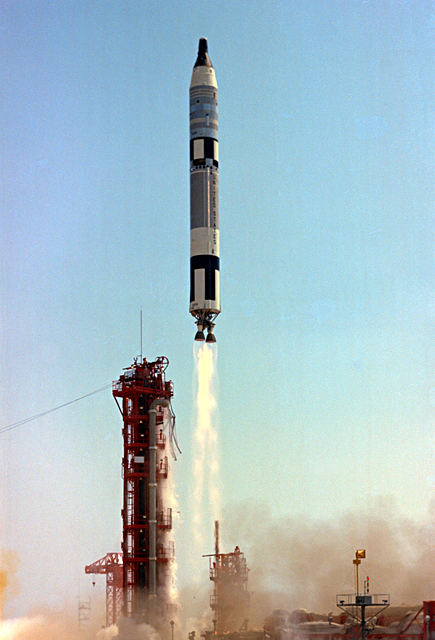
This beautiful display has some serious science behind it. You all know that as the orbiter ascends, it is traveling through increasingly rarefied atmosphere, until it reaches a near vacuum at orbital altitude. You also know that the Space Shuttle Main Engines (SSME) works off of Newton's First Law of Motion, and the action of the exhaust leaving the engine bell produces the reaction of the engine and shuttle moving away. The exhaust does not need to 'push' against anything to produce thrust. While this is true, the exhaust does push against something, the gasses of atmosphere. At sea level, atmospheric pressure helps constrain the exhaust into the familiar plume we see.


This Gemini-Titan launch shows an exhaust plume
constrained by sea level atmospheric pressure.
(Image by NASA)

As the rocket ascends, the thinner atmosphere allows the exhaust plume to expand. Engineers plan for this with the shape of the engine exhaust bell. Second-stage engine bells designed to work at high altitude are different than those on the first stage booster. Some engines are designed with an extendable collar that slips down at high altitude to take advantage of the expanding exhaust by increasing the length of the bell.

Notice different exhaust plume indications in this simplified SSME illustration.
(Image by Pratt and Whitney)

The SSMEs are designed to operate through the whole atmosphere, and optimized for mid altitudes after solid rocket booster seperation. When the orbiter reaches higher altitudes the exhaust rapidly expands. Although this lowers the efficiency of the SSME, the decreasing weight of the external tank and lack of atmospheric drag allow it to continue to thrust the shuttle to orbit. The video above (which appears to have been taken from near the US 1 highway in Titusville, FL) shows this expanding plume. Remember, this happens on every flight. What made this different was the darkness of the sky and the plume being illuminated by the sun just over the horizon. A beautiful confluence of technology and nature.

Aftermath of the launch plume in the light of sunrise.
(Picture by Jim Gerard)